Jump to section
- Choose the structure before choosing the payment
- Business lease application: the steps to confirm
- Request the correct application
- Ask about a personal guarantee explicitly
- Budget for the business you actually run
- Understand the deduction before using it in a budget
- Separate employee personal-use reporting from the lease payment
- Use tax examples as questions for your accountant
- Keep an audit trail for the business decision
- Compare a business lease with buying
- Key takeaways
- Frequently asked questions
The quick guide
Before you decide
- Confirm the legal lessee and lender requirements early.
- A company name does not settle tax treatment or liability.
- Keep the application, vehicle budget and tax analysis separate.
Choose the structure before choosing the payment
To lease a luxury SUV through your business, identify the legal lessee and authorized signer, choose a vehicle and realistic mileage allowance, then submit the lender’s business application. Review any personal guarantee and the full quote before signing. Approval, insurance and tax treatment are separate checks; neither an LLC nor a heavy SUV guarantees a particular result.
A business vehicle transaction starts with identifying who will sign the agreement and how the car will be used. Ask whether the lessee will be the company, an individual or another approved structure. Keep the registration, insurance and payment arrangement consistent with the documents you will sign.
An LLC name on a conversation or quote is not a substitute for a properly structured application. Discuss the intended arrangement with your accountant and insurance adviser before deciding it is better than a personal lease. The useful question is what fits your entity, use and lender—not whether the company name sounds more professional.
Business lease application: the steps to confirm
Use this sequence to prepare the transaction. The lender sets the actual requirements and decides approval; the checklist does not promise that every business qualifies.
| Step | What to establish | What to keep |
|---|---|---|
| 1. Set the structure | Legal entity, authorized signer, intended drivers and insurance for the intended use. | Consistent company information and insurer instructions. |
| 2. Confirm lender requirements | Business application route, requested financial records and any owner or guarantor assessment. | The lender’s document checklist and guarantee terms. |
| 3. Compare the quote | Exact vehicle, term, total annual miles, payment and itemized cash due at signing. | Matched written proposals and their conditions. |
| 4. Review before delivery | Final approval, signed obligations, insurance, registration and tax-record plan. | Executed documents and vehicle handover records. |
Request the correct application
Tell us the company’s legal name, entity type, intended driver, vehicle and desired budget. We can identify the appropriate business-application route. Ask the lender which documents are required rather than assuming a standard consumer form is sufficient for the proposed transaction.
Prepare requested information using current, consistent records. A mismatch in the legal name or address can create avoidable clarification. Keep sensitive records within the designated application process. The initial conversation can establish what is needed without sending tax returns or identity documents through casual messages.
For example, Mercedes-Benz USA’s credit application disclosures say a business applicant may need current and year-end financial statements, including a profit-and-loss statement and balance sheet. That is a lender-specific example, not a universal list. Ask which records your proposed lender requires and who must authorize the application.
Source: Mercedes-Benz USA: business credit application disclosures
- Legal entity name and contact details.
- Intended driver and business use.
- Vehicle, term and annual mileage.
- Available drive-off and monthly budget.
- Documents specifically requested by the lender.
Ask about a personal guarantee explicitly
A lender may require an owner or another approved person to guarantee the obligation. Do not assume a company lease is automatically without personal responsibility, or that every established company receives the same treatment. Request the lender’s requirements and the actual guarantee documents.
Ask who remains responsible if the business cannot pay and which applicant information will be assessed. If the available program requires a guarantee you are unwilling to provide, resolve that before treating the quote as actionable. The proposed payment does not answer the liability question.
- Entity
- Lender approval
- Use and insurance
- Tax review
A framework for your comparison—not a guarantee of eligibility or cost.
Budget for the business you actually run
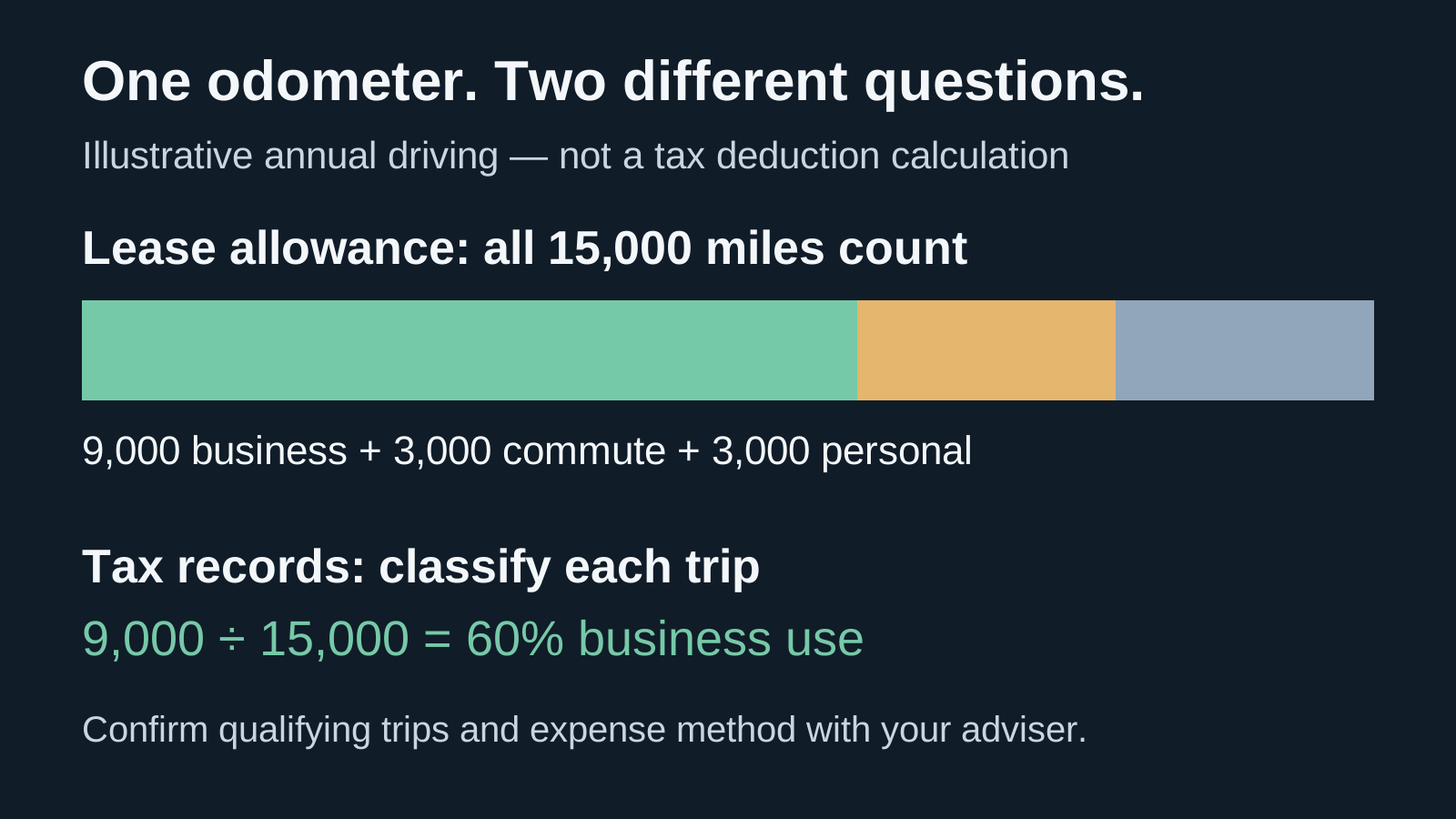
Estimate business and personal driving separately. Include client visits, trips between work locations and any personal use; ask your tax adviser how each category is treated. Then select a total mileage allowance that accommodates actual vehicle use. Tax mileage and the lessor’s odometer allowance answer different questions.
Build a monthly cash budget that includes insurance for the intended use, fuel or electricity, maintenance and the lease. Consider how the obligation fits seasonal income or changing staffing. A car that feels affordable in a strong month still needs to work during a quieter period.
Suppose you expect 15,000 total miles: 9,000 qualifying business miles, 3,000 commuting miles and 3,000 other personal miles. The lease allowance must cover all 15,000, while the illustrative business-use share is 9,000 divided by 15,000, or 60%. Classify the actual trips with your adviser; ordinary commuting does not become business mileage because the company pays for the car.
Understand the deduction before using it in a budget
IRS guidance explains that business vehicle expenses depend on the method used and the qualifying business-use portion. A leased car’s payment is not automatically a dollar-for-dollar reduction in tax. The rules can include an inclusion amount, and you cannot deduct lease costs in addition to the standard mileage rate for the same use.
If eligible and choosing the standard mileage method for a leased car, IRS Publication 463 requires that method for the entire lease period. For a self-employed person with mixed business and personal use, actual-expense deductions generally use the qualifying business-use portion. Advance lease payments must be spread over the lease period. Ask your adviser to check the method and any inclusion amount before estimating a deduction. Keep a timely trip record rather than treating the lessor’s mileage allowance as tax evidence.
Separate employee personal-use reporting from the lease payment
For a company-provided employee vehicle, ask your tax adviser about personal-use benefit reporting and the entity’s deduction treatment. IRS Publication 15-B addresses employer-provided vehicle benefits; a business-use percentage alone does not settle payroll reporting or the company’s deduction. Keep records of who drove, when, where and for what business purpose.
Source: IRS Publication 15-B: employer-provided vehicle benefits
Use tax examples as questions for your accountant
Assume, only to illustrate the distinction, that a proposed expense deduction is $6,000 and an applicable marginal rate is 25%. Multiplying those inputs gives $1,500, not a $6,000 reduction in tax. This is arithmetic, not a determination that an expense qualifies or that a rate applies to your entity.
Keep taxes outside the core cash budget until your adviser has checked the method, records and business-use allocation. If your plan depends on the vehicle being deductible in a particular year, get that advice before signing. Buying and leasing also follow different deduction mechanisms; do not attach a purchase write-off to an ordinary lease.
Keep an audit trail for the business decision
Save the proposal, application correspondence and final documents in a place the people responsible for the vehicle can access appropriately. Record who may drive it, who approves expenses and who tracks service and mileage. These operational questions matter even when the business has only one owner and one car.
Create a simple monthly review: confirm the payment, record vehicle-related expenses and check whether actual use still matches the original plan. If the vehicle shifts from one driver or role to another, ask the appropriate insurance and tax professionals whether the arrangement needs updating. A company vehicle should remain a documented business decision after the excitement of delivery has passed.
Before choosing a higher-cost specification, write the business reason and the incremental cash commitment over the term. Client comfort or a required capability can be relevant; a general expectation of a write-off is not a substitute for a budget. Compare the extra amount with other uses of business cash. This leaves a clearer record of why the vehicle fits the company and what it will cost to keep.
Compare a business lease with buying
Request an all-in lease proposal and a purchase or financing proposal for the same suitable vehicle. Include expected holding period, cash tied up, mileage and the cost of changing cars. A tax benefit alone is not a reason to choose a vehicle your business does not need.
Bring the proposals to your accountant together with the intended use. If you are evaluating a heavy SUV purchase, use our Section 179 guide as a starting checklist, then confirm eligibility and current-year treatment. The transaction should work as transportation and as a business commitment before any tax result makes it look attractive.
Take it with you
Key takeaways
- Confirm the legal lessee and lender requirements early.
- A company name does not settle tax treatment or liability.
- Keep the application, vehicle budget and tax analysis separate.
Put the assumptions in writing before comparing quotes.
Frequently asked questions
Does an LLC guarantee approval?
No. The lender evaluates the proposed application and sets its requirements.
Is a personal guarantee always required?
Requirements depend on the lender and program. Ask about the actual proposed transaction and read the documents.
Can I deduct the entire payment?
Not automatically. Business use, the expense method and other tax rules affect the result; confirm with your adviser.
Is leasing the same as a Section 179 purchase?
No. An ordinary lease and a vehicle purchase use different tax mechanisms. Compare them separately.
Does my lease mileage allowance equal deductible business mileage?
No. The lease counts total vehicle use, including commuting and personal trips. Tax records separately identify qualifying business use. Select enough total lease miles, then have your adviser classify trips and confirm the deduction method.
Sources & editorial notes
Sources checked November 6, 2026. Examples are illustrative unless identified otherwise. Vehicle photos do not certify inventory, eligibility or current offers.
Explore your options
Your next step
Put real numbers beside the advice.
Tell us the car, mileage and budget you have in mind. We’ll help compare the available options.
Get a clear quote ↗Explore current deals