Jump to section
- Start with the contract you already have
- Returning the car: inspect before handover
- Compare repairs with the actual return charge
- Buying it: use a dated, complete quote
- Separate the residual, quote and cost to own
- Work out the acquisition total before financing
- California buyouts: confirm who collects the tax
- Replacing or trading: separate the transactions
- Extensions and early exits need separate approval
- Build a side-by-side decision sheet
- Close the account as carefully as the handover
- Key takeaways
- Frequently asked questions
The quick guide
Before you decide
- Request your lessor’s instructions and a dated buyout quote.
- Compare all-in options, including fees and next-car costs.
- A replacement transaction does not erase the old obligation.
Start with the contract you already have
At lease end, your decision is about an existing car and a specific agreement. Begin with the maturity date, remaining payments, mileage allowance, purchase-option language and return instructions. A general description of lease end cannot tell you what your lessor will charge or allow.
Create three comparable scenarios: return and replace, purchase and keep, or another option expressly approved by the lessor. An extension or trade-in route may be available, but request the actual terms before using it as the foundation of your plan. Keep making required payments while you work through the decision.
Returning the car: inspect before handover
Ask how to arrange a pre-return inspection and where the car may be returned. Use the lessor’s condition standards to assess tires, glass, body damage, missing equipment and service records. Mercedes-Benz’s US lease-end guidance, for example, discusses vehicle condition and excess-mileage assessment; your own lessor’s instructions govern your return.
Compare repairs with the actual return charge
Do not authorize every repair simply because you are returning the car. First obtain the inspection result and ask what can be remedied before return. Compare a compliant repair quote with the expected contractual charge. Keep receipts and photographs of work performed.
For an illustrative example, a $250 repair against a documented $500 charge may be worth considering. A $700 repair against that same charge needs a different justification. These figures are only decision math. They do not establish your lessor’s damage standard, waiver policy or final bill.
Buying it: use a dated, complete quote
Request a purchase quote directly from the lessor and check its expiration date. Include applicable taxes, purchase-option fees, registration and financing cost when comparing it with replacing the car. A residual value printed in the original lease is not automatically the complete amount you must pay today.
The car’s history is useful information you already possess. Consider its condition, service needs, remaining warranty and how well it still fits. If you need a loan, compare the total financed amount and terms. Avoid deciding from the buyout payment alone; a longer loan can change the monthly number without making the car cheaper.
BMW Financial Services, for example, directs customers to Payoff Information in their account or the My BMW App for the current buyout amount. Use your own lessor’s authorized quote process. Check who may use the quote, when funds must arrive and which taxes or fees it already includes before comparing another proposal.
Source: BMW Financial Services: finding the current buyout amount
- Return costs
- All-in buyout
- Eligible offers
- Next-car budget
A framework for your comparison—not a guarantee of eligibility or cost.
Separate the residual, quote and cost to own
Keep these figures on separate lines. The contract’s residual is used in the lease calculation; a current purchase quote addresses the transaction you are considering now. Regulation M separately addresses residual-value and purchase-option disclosures for covered consumer leases. Ask the lessor to explain the actual purchase terms rather than treating every lease as though it has the same buyout formula.
Source: CFPB: residual value and purchase-option disclosures
| Figure | Where to obtain it | How to use it |
|---|---|---|
| Contract residual and purchase option | Original agreement and any applicable amendments. | Understand the original lease calculation and contractual purchase terms. |
| Dated buyout quote | The lessor’s authorized purchase process for the proposed buyer. | Check expiration, payment instructions, included charges and buyer eligibility. |
| Cash acquisition total | Quote plus applicable tax, title, registration and other costs not already included. | Compare what you must pay to acquire the car without double-counting. |
| Financed ownership budget | Loan proposal plus insurance, service and expected running expenses. | Compare loan term, interest, cash needed now and what you will still owe later. |
Work out the acquisition total before financing
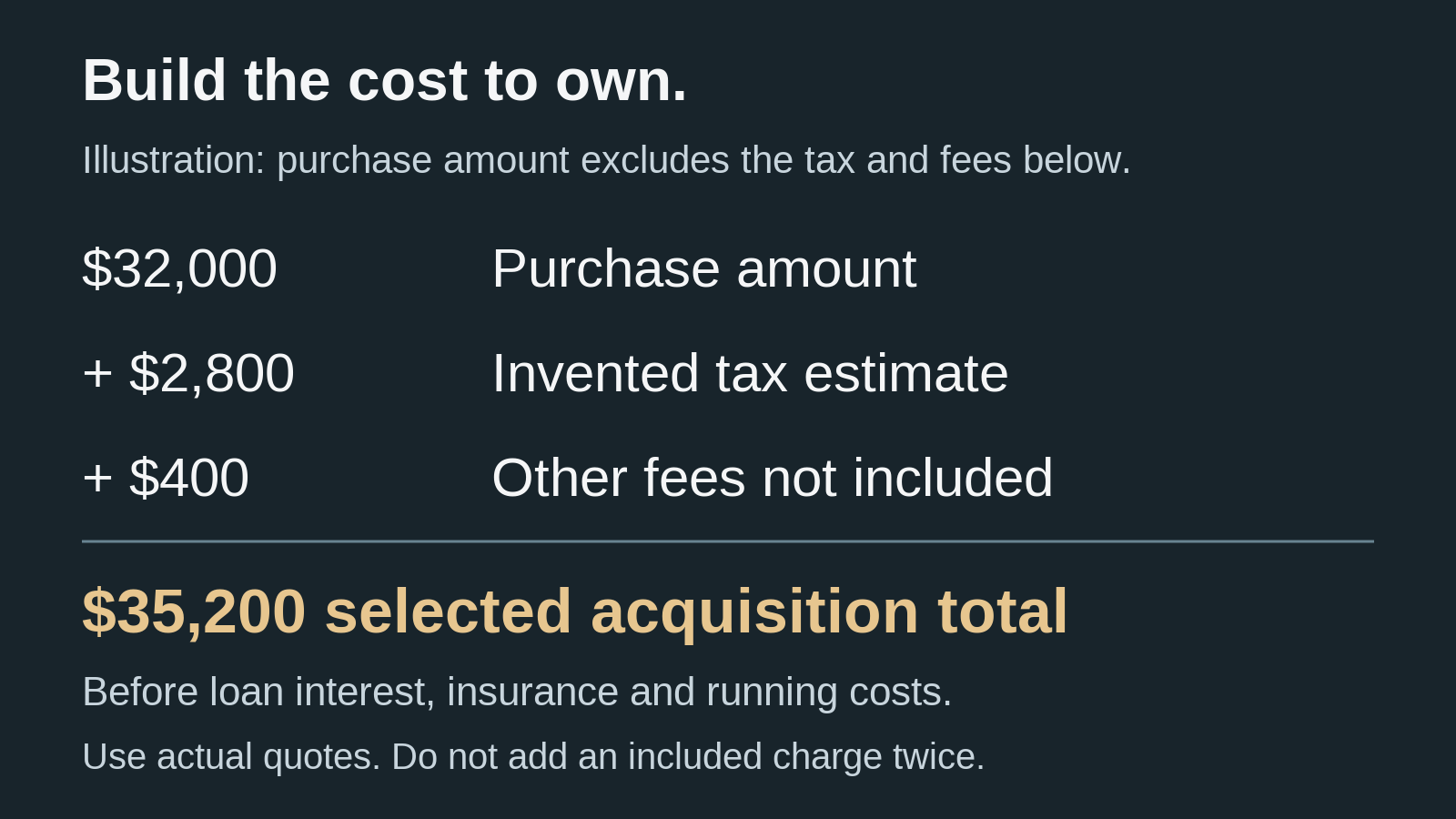
Assume an illustrative written purchase amount of $32,000 that excludes tax and other transaction fees. Add an invented $2,800 tax estimate and $400 of other fees not already included. The selected cash acquisition total is $35,200 before loan interest, insurance, maintenance or other running costs. These figures are not a current offer, tax rate or fee schedule.
Replace every input with the dated quote and the applicable tax and fee information. If the quote already includes tax or a purchase-option charge, do not add it again. List separately any additional amount the lessor says remains payable. If you finance part of the purchase, reconcile the loan amount and cash contribution with this worksheet, then compare interest and the remaining loan balance over your intended holding period.
California buyouts: confirm who collects the tax
CDTFA states that purchasing your leased vehicle at lease end is subject to tax. It also explains that, when a dealer is not handling the buyout, the bank or leasing company may not collect it; you may then be responsible for paying use tax at DMV when registering the vehicle. A purchase quote that omits tax is not evidence that no tax is due.
Ask the lessor or handling dealer which amounts it will collect and confirm any separate DMV payment. Use the applicable transaction and registration details to obtain the correct amount. This is a purchase-to-keep checklist; if you are considering a different transaction or claiming an exemption, obtain the applicable guidance rather than assuming this example settles that situation.
Replacing or trading: separate the transactions
Ask whether a proposed buyer is permitted to purchase the vehicle and which payoff applies. Restrictions and payoff amounts can depend on the lessor and transaction. Do not assume that an outside valuation equals money available to you. Compare an actual purchase offer with the payoff that buyer can use.
For example, an eligible offer of $40,000 against a $38,500 applicable payoff suggests a $1,500 gap before other transaction costs. If the buyer cannot use that payoff, the arithmetic is not a realizable offer. Ask for the settlement details in writing before applying any expected equity to a new lease.
Extensions and early exits need separate approval
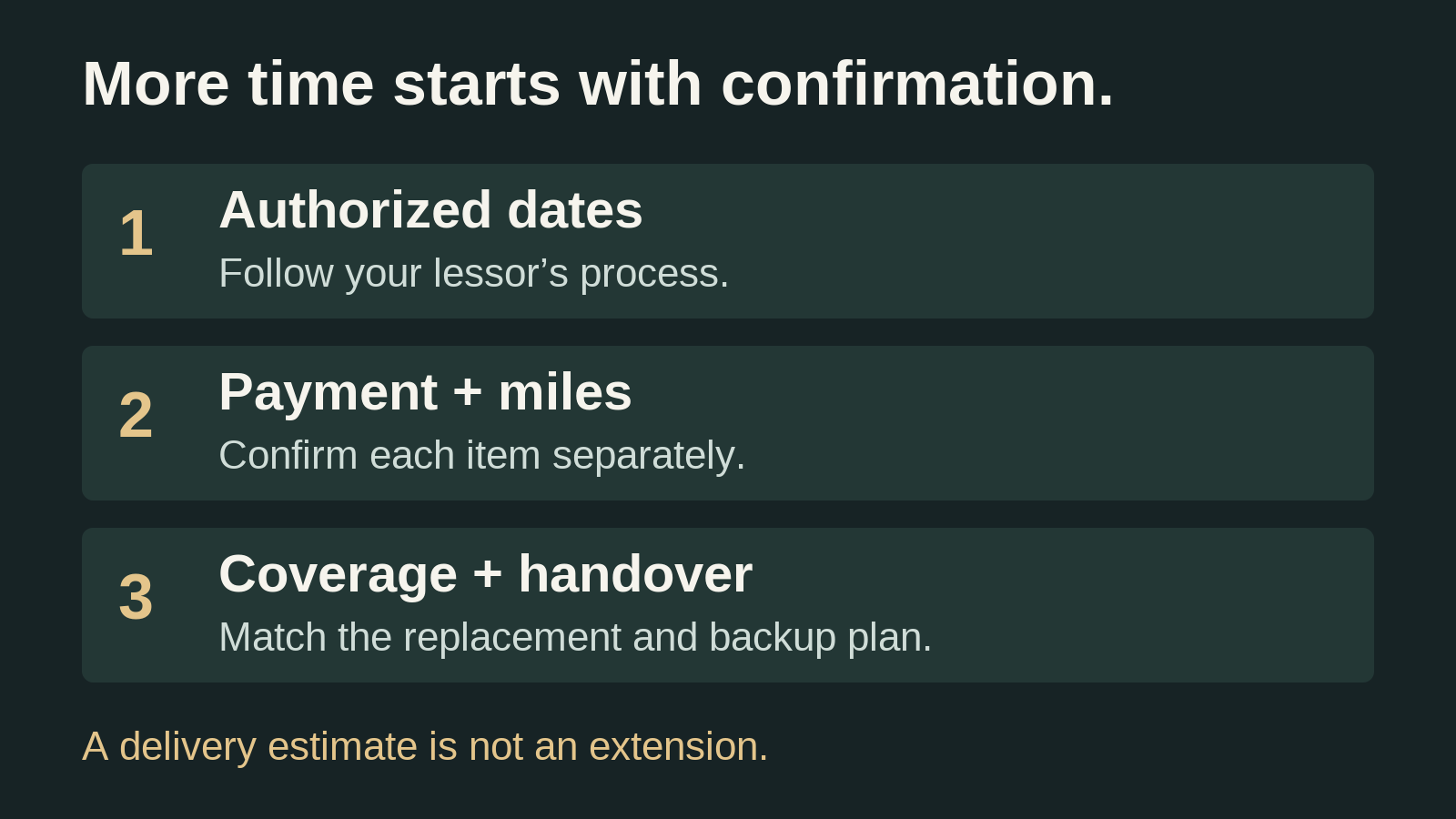
If the replacement car will arrive late, ask the lessor whether an extension is available and what happens to payments, mileage, registration, insurance and purchase options. Record the approved end date. A dealer delivery estimate is not permission to keep a leased car beyond the agreement.
Leaving before the scheduled end can be expensive. The Federal Reserve explains that early termination charges are defined by the lease and may be substantial. Request a current settlement rather than assuming you owe only the remaining payments.
Build a side-by-side decision sheet
For return-and-replace, list the current lease’s remaining obligations and the complete proposal for the next car. For buy-and-keep, list the dated buyout, applicable transaction expenses, financing and expected service needs. For an approved extension, write down the new end date, payments and mileage treatment. Keep uncertain amounts visibly marked until confirmed.
Use the same future period for all three scenarios. If you are deciding how to cover the next twelve months, a three-year advertisement needs to be understood as a longer obligation, not merely a twelve-month transport cost. Likewise, a buyout leaves you with a vehicle and possibly a loan after that period. State what remains at the comparison date.
Your preference for the current car is legitimate information. A known service history, a specification you like and avoiding another shopping process may matter. Put those reasons beside the numbers rather than disguising them as a guaranteed bargain. Once the financial and practical outcomes are visible, choose deliberately. Keep the supporting quotes so you can verify the final transaction against the decision you made.
Close the account as carefully as the handover
Before return, gather keys, accessories, records and the items the lessor requests. Photograph the vehicle and odometer, obtain a dated return receipt and keep the receiving location’s details. Follow up on the final account statement instead of assuming the receipt means the balance is zero.
For the next vehicle, compare a fresh quote independently. A loyalty benefit can be useful when confirmed, but evaluate the full replacement cost after any benefit. Bring us the current car’s maturity date, mileage and intended next vehicle so the timing and comparison can be planned together.
Take it with you
Key takeaways
- Request your lessor’s instructions and a dated buyout quote.
- Compare all-in options, including fees and next-car costs.
- A replacement transaction does not erase the old obligation.
Put the assumptions in writing before comparing quotes.
Frequently asked questions
Do I have to lease another car from the same brand?
Check your contract and any conditional benefits. Evaluate your return obligation separately from the choice of replacement vehicle.
Is the residual my full buyout price?
Not necessarily. Request a dated purchase quote including the applicable fees and taxes.
Can a third-party dealer buy the car?
Ask your lessor. Confirm buyer eligibility and the payoff applicable to that transaction.
Does returning the car settle everything?
Keep the receipt and check the final statement for remaining payments, fees or condition charges.
Does tax paid during the lease mean the buyout is tax-free?
Do not assume so. California CDTFA states that a lease-end vehicle purchase is subject to tax. Confirm the actual amount and who collects it; tax missing from a lessor quote may still need to be paid at registration.
Sources & editorial notes
Sources checked November 6, 2026. Examples are illustrative unless identified otherwise. Vehicle photos do not certify inventory, eligibility or current offers.
Explore your options
Your next step
Put real numbers beside the advice.
Tell us the car, mileage and budget you have in mind. We’ll help compare the available options.
Get a clear quote ↗Explore current deals